Integrity Corporate Services · 31 October 2026
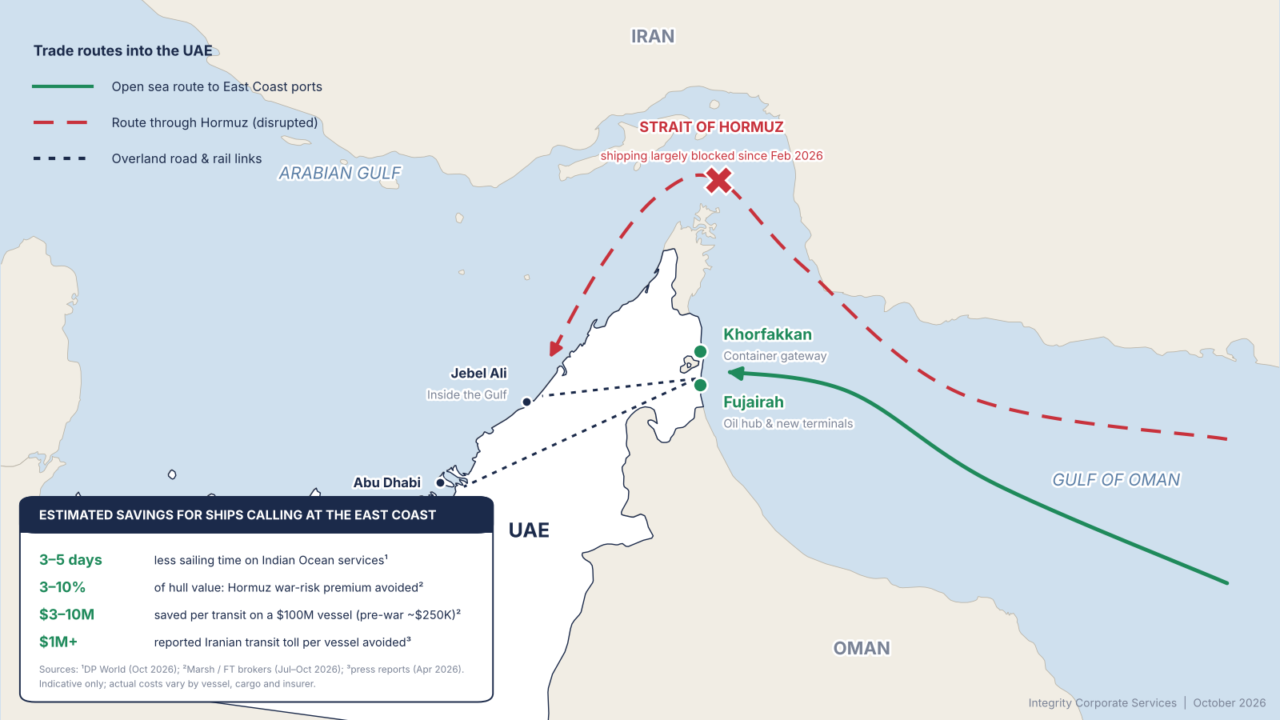
Since 28 February 2026, shipping through the Strait of Hormuz has been largely halted. A ceasefire in April and a memorandum in June brought brief relief, but attacks on commercial vessels resumed in July and the strait remains effectively closed to normal traffic. In late October, monitors recorded just two commercial transits in a day, against a pre-crisis average of around 85.
For any business that imports, exports or moves goods through the UAE, the question has changed. It is no longer when will Hormuz reopen? It is how do we build a supply chain that does not depend on it? Increasingly, the answer lies on the UAE’s East Coast, in Fujairah and Khorfakkan.
Geography that matters
Fujairah and Khorfakkan sit on the Gulf of Oman, outside the Strait of Hormuz. Vessels arriving from Asia, Africa and Europe can berth there directly, without entering the Arabian Gulf at all. Cargo then moves overland, by road and increasingly by rail, to Dubai, Sharjah, Abu Dhabi and beyond.
When the strait closed, this geography stopped being a theoretical advantage and became a lifeline. Activity at Jebel Ali, the region’s largest container port, fell by as much as 95% at the height of the disruption, and shipping lines rerouted UAE-bound cargo through the East Coast and onward by land.
Fujairah: from energy hub to multipurpose gateway
Fujairah has long been one of the world’s leading bunkering and oil storage centres, and it is the UAE’s main oil export route that avoids Hormuz. The Abu Dhabi Crude Oil Pipeline (ADCOP) carries crude from Habshan to Fujairah’s export terminal. A second pipeline, accelerated by the Abu Dhabi leadership in May 2026, was reported to be about half complete and is expected to come online in 2027, doubling ADNOC’s export capacity through Fujairah.
The emirate’s role is now expanding well beyond oil:
- New container and cargo terminals. In July 2026, DP World reached an agreement in principle with the Fujairah Ports Authority, under a 50-year concession, to develop the Al Rugaylat container and multipurpose terminal and the Dibba general cargo terminal, linked overland to Jebel Ali.
- Rail connectivity. In September 2026, Etihad Rail and AD Ports Group launched a thrice-weekly freight service from Fujairah Terminals to the Industrial City of Abu Dhabi (ICAD), roughly 200 km, where containers can be inspected, cleared and released. Passenger rail between Abu Dhabi and Fujairah also began on 30 June 2026.
- Diversifying cargo. Etihad Rail has already moved its first commercial shipment of cars by rail from Fujairah to Abu Dhabi, showing the corridor can carry high-value goods as well as bulk.
Khorfakkan: the East Coast container gateway
Khorfakkan, operated by Sharjah-based Gulftainer, is the UAE’s largest container port outside Hormuz, and 2026 has transformed it.
- Volumes. Gulftainer reported that weekly container handling jumped from about 8,000 before the crisis to around 65,000.
- Investment. Gulftainer has brought forward a USD 2 billion strategy covering port capacity, logistics parks and shipping services.
- Capacity. The terminal is being expanded from 3.5 million to 5 million TEU a year, with a long-term masterplan exceeding 10 million TEU.
- Deep water. With depth exceeding 17 metres, Khorfakkan can receive some of the largest container vessels in operation.
- Inland reach. Cargo can move under bond to the Sajaa dry port, about 90 km away, and be cleared closer to the customer. Integration with Etihad Rail is planned, giving a full sea–road–rail gateway.
From temporary bypass to permanent hub
What began as an emergency reroute is turning into lasting infrastructure. Fifty-year port concessions, new pipelines, rail links and multi-billion-dollar terminal expansions are not short-term measures. Even if Hormuz traffic normalises, shippers, insurers and investors are unlikely to return to dependence on a single chokepoint. Jebel Ali will remain the UAE’s principal hub, but the East Coast is becoming the second, essential pillar of the country’s logistics network.
The East Coast is not risk-free. Fujairah’s oil facilities were struck by drones in March 2026, briefly suspending loadings. But operations resumed quickly, and the combination of a position outside the strait, multiple ports and several overland routes gives businesses options that a single Gulf-side port cannot.
For companies, this creates a clear opportunity: to establish operations, warehousing, trading and distribution on the East Coast now, while capacity, land and partnerships are still being shaped.
What businesses need to get right
Moving into this new corridor is not only a logistics decision. It raises regulatory and compliance questions that need to be answered before the first container lands:
- Where to set up. Free zone or mainland, and in which emirate, depending on customers, activities and how goods will move.
- The right licence activities. Trading, logistics, warehousing, freight forwarding and related activities must match what the business actually does.
- Government approvals and registrations. Licensing, permits and registrations with the relevant authorities in each emirate.
- Tax. UAE Corporate Tax and VAT treatment of new entities, free zone structures and cross-emirate movement of goods.
- AML/CFT and sanctions compliance. Rerouted trade flows in a conflict region attract closer scrutiny. Robust customer due diligence, sanctions screening and trade-based money laundering controls are now expected by regulators and banks alike.
- Banking. Opening and maintaining bank accounts for trading and logistics businesses, which face enhanced due diligence in the current environment.
How ICS can help
Integrity Corporate Services (ICS) Main office is located in Fujairah and serves more than 100 free zone and mainland clients across the UAE. We understand both the opportunity on the East Coast and the regulatory framework that governs it.
We support businesses with:
- Government approvals, permits and registrations across the relevant UAE authorities
- UAE Corporate Tax and VAT compliance
- Bookkeeping and IFRS financial statements
- AML/CFT compliance, including outsourced MLRO and Compliance Officer services, risk assessments, policies and sanctions screening frameworks
- Corporate and personal banking solutions
- Whether you are relocating part of your supply chain, opening a trading or logistics entity on the East Coast, or reviewing your compliance in light of new trade routes, ICS can guide you from licence to operation.
Talk to our team today to plan your East Coast Opportunities. +971 585 232666
This article reflects publicly reported developments as of 31 October 2026. It is for general information and does not constitute legal, tax or investment advice.